Investment · Uzbekistan
Uzbekistan–U.S. $12 billion agenda: the opportunities beyond the headline
Samarkand has put industrial partnerships, critical minerals and international capital on the same agenda. CAPPA examines where investors and suppliers could participate as the announced projects take shape.
Visit outcomes · announced agreements and initiatives · CAPPA investor assessment
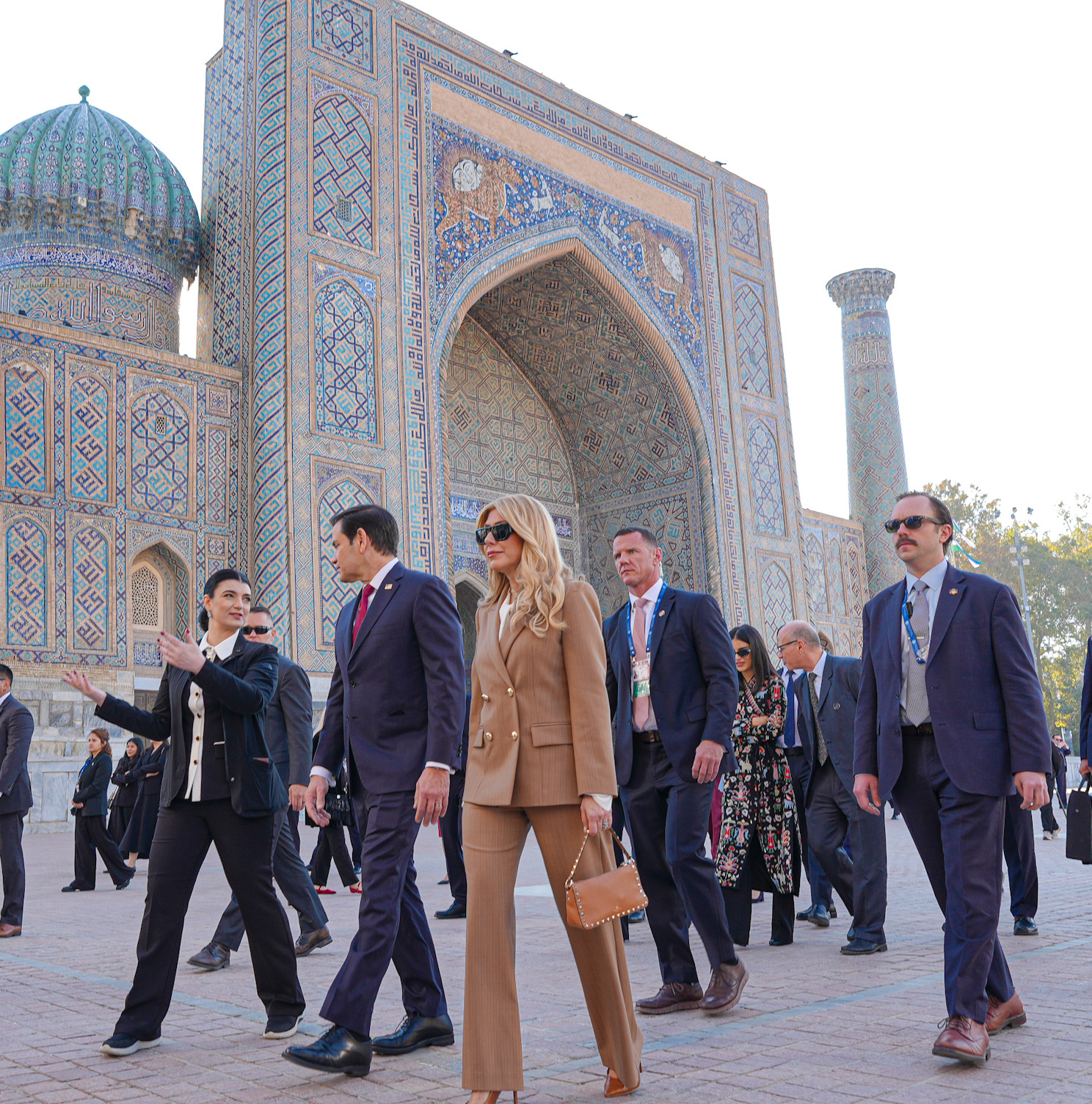
Freddie Everett / U.S. Department of State · public domain ↗
What the visit produced
At the second American–Uzbek Business and Investment Council meeting on 19 October, President Shavkat Mirziyoyev described 54 agreements and prospective initiatives worth approximately $12 billion. U.S. Secretary of State Marco Rubio attended. The presidency said an implementation programme would be developed. This is an announced portfolio spanning different stages, rather than a measure of investment already received.
Yep.uz, reporting the investment ministry’s announcement on 20 October, identifies GE Aerospace for aircraft engines and Wabtec for railway localisation; ReElement Technologies, Traxys and Trafigura for minerals; and Franklin Templeton, Oppenheimer & Co., Citigroup and BlackRock for capital-market cooperation. It also names Amazon Leo in satellite connectivity, GE HealthCare in medical technology and Valmont Industries in agriculture. Its report does not provide a complete project list, individual transaction values or implementation dates. These company-level descriptions are attributed reporting; CAPPA has not reviewed the underlying contracts.
CAPPA analysis: why it matters
For CAPPA, the commercial significance is the potential connection between industrial demand, technology and financing. A new facility may create work for local suppliers, engineering firms, logistics providers and service businesses before it becomes an investable operating asset. Investors can start preparing now by identifying the specific counterparties, procurement needs and milestones relevant to their mandate. The opportunity is to turn broad interest in Uzbekistan into a small number of well-documented decisions.
Three practical ways to participate
Industrial suppliers and strategic partners can investigate localisation requirements, maintenance, workforce training and supporting infrastructure. A useful first proposal would specify what the company can deliver, which local capabilities it needs and who would purchase the output. Participation in the announced package does not by itself establish an open tender or an available supplier contract.
Minerals investors and processors should distinguish resource ownership, extraction, processing and offtake. Each has different funding needs and commercial risks. Before discussing valuation, establish the licence holder, independently supported resource information, processing requirements, infrastructure and prospective buyer. The announcements reviewed do not establish a specific new uranium contract.
Funds and lenders can begin with the borrower or project company, the required instrument and the route to repayment. Capital-market cooperation could help companies prepare for financing, but a named international institution is not proof of an approved investment, guaranteed placement or available credit line.
The policy development worth watching
The presidency also outlined a proposed “plug and play” approach: projects prepared with sites, infrastructure and permissions, alongside potential participation by local partners and a direct-investment fund. A trade, investment and technology programme through 2035 was proposed. The next useful evidence will be the operating arrangements and specific eligible projects.
For a business entering Uzbekistan, a prepared site could shorten development work. Its value must still be demonstrated through documents: available utilities, valid permissions, allocation of infrastructure costs and a credible delivery schedule. CAPPA’s assessment is that readiness and execution will increasingly distinguish attractive projects within the wider investment agenda.
Questions before the next commitment
- What document has been signed, by which legal entities, and what remains conditional?
- Is the opportunity a supply contract, joint venture, equity investment, loan or an early-stage initiative?
- Who controls the site, permits and procurement process, and what is the next decision date?
- What funding is committed, what is still sought, and which party carries completion and payment risk?
A practical next step
CAPPA can help organise a focused Uzbekistan market-entry or project-screening engagement: clarify the investment mandate, identify relevant local counterparties, assemble available evidence and map the steps to due diligence. Send a non-confidential brief with your sector, preferred participation, approximate investment range and timetable to info@cappa.uz. We can then agree a concrete scope of work. CAPPA does not claim an appointment by the companies named in this article.
Discuss your Uzbekistan investment brief with CAPPA →